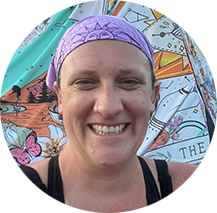

Photo: Provided by Midwest Everest | Digital Art: Stephanie Thwaites
Midwest Everest – What goes up, must come down – again and again and again
The West Michigan trail run where participants climb over 29,000 feet
Story By: Elizabeth Roersma
Photos By: Holly Espinoza, Jamie Geysbeek, and Jay Bolt, Provided by Midwest Everest
Typically, the plan when approaching a ski hill is simple.
Go up the lift. Go down the hill.
By ski, by snowboard, maybe even by tube or sled.
But when it is September in Michigan and there is no snow, things get a little backwards.
One weekend every year, for 36-hours more than a dozen people gather at Cannonsburg Ski Area in West Michigan to run, walk, and support the Midwest Everest, an ultra-marathon race that offers people the opportunity to go up to 100 miles and 30,000 feet in elevation up and down a Midwest ski hill and over and through about 8 miles of wooded trails.
There is also a 10K, 20K, and 50-mile run offered during the weekend, attracting runners who want to get a taste of the challenge and camaraderie offered.
This race is one of many worldwide race events that feature “Everesting”, or going the distance and elevation of Mount Everest. It is a tradition of trail runners and cyclists, and can be completed by one participant or by many in an event.
What sets this race apart is the size of the hill, explains Holly Espinoza, one of the race directors.
“The idea of Everesting isn’t original,” she said. “Out West, people do this on the bigger mountains, so our uniqueness is the small height of the hill.”
This difference creates a feeling of community for runners, their crews, other spectators, and volunteers, Espinoza said.
“What makes this race specifically unique is getting to see crew and have aid every .6 miles, with the exception of the trail miles. Racers are able to bring a canopy, chair, cooler, etc., with everything they want, in addition to a fully stocked aid station,” she said. “Additionally, our crew works hard to get to know racers and their crew and help out in any way possible. Many return racers comment on the “family” type atmosphere we create.”

Photo: Event participant Joe Bliss, Provided by Midwest Everest
Joe Bliss
When choosing a 100-mile race, this stood out to runner Joe Bliss.
“Midwest Everest allows racers to spend a lot of time around people they care about while running. At most ultras, you briefly see your crew and maybe have a pacer, but with this race format, you see everyone at the bottom of each loop. You have to be careful not to waste too much time at the bottom of that hill,” he said.
Even with the support, Bliss said it still stands as his hardest race.
“The loops and elevation gain/descent make it hard to find a rhythm or to tick off any easy miles,” he said.
But the gains are worth it.
“I gained confidence in my running and my ability to push through ultras when everything gets hard,” he said.
For Bliss and other runners, the experience is tough but does not deter them from returning. He is planning to come back this year as a volunteer.
While they have gained in popularity, many who have raced this event say it is the hardest race they have ever done.
So what brings them back, year after year?

Photo: Provided by Midwest Everest

Photo: Event participant Shannon McCormick, provided by Midwest Everest
David Crawford
“It’s the camaraderie,” said David Crawford, an event volunteer known for keeping the participants fed during their hours on the course.
Runners pass through their base camp so frequently that they become acquainted with the other participants, their support groups, volunteers, and anyone else visiting the course over the weekend.
“Unlike a lot of races, I get to see the racers 152 times on the hill, plus four loops for 156 times. They might not check in every time, but by the time I am done, I have gotten to know a lot of the racers. It’s not just someone passing by.”
Crawford makes it personal by taking orders for omelets, eggs, and more – even specialties like Midwest Sushi and Midwest tacos, which are tortilla, cream cheese, and pickle roll-ups, and fried cheese with bacon inside, respectively.
“You build this small community in two days,” he says of the runners, supporters, and volunteers.
His favorite part, besides feeding the runners, is sitting around at night with the race directors and choosing music to encourage the runners through the late night and early morning hours. In addition to volunteering at Midwest Everest, Crawford had also been a pacer, runner, and volunteer for other races.
After 6 years of Midwest Everest, Crawford said he is surprised at the rate at which runners return, year after year.
“The race is set up to be terrible,” he said with a laugh. “In my mind, no one should ever do it; once or twice is just impressive, and I think no matter how hard it is, people just enjoy that the race is different.”
“The sense of community that the race directors have built in design and personality brings people back for torture,” he said.

Photo: Event participant Jesus Vasquez, provided by Midwest Everest

Photo: Event participant Jesus Vasquez, provided by Midwest Everest
Jesus Vasquez
One of those people who has not only come back, but gone to win the race is Jesus Vasquez. For Vasquez, the experience was life-changing.
“I had no ultra-running experience,” he said, having decided in 2019 to run a marathon, only to have it canceled due to the COVID-19 pandemic in 2020. Instead, he decided to try the Midwest Everest trail race and see how it went.
“I didn’t even finish 43 miles,” he said.
But that DNF (did not finish) did not stop him.
“When I did not finish the first time, it set that fire in me. It changed my whole life, even just the DNF,” he said.
In 2023, he came back and set the course record, finding ways to continue through the dark of night, early morning, and hours of hill repeats. And with each loop, the site of your own camp, with comfort, support, and maybe the urge to be done with the race.
“You are constantly coming by your camp,” he said. “It’s so easy to think, ‘Man, I could stop right now.’ It takes a lot of mental grit to just keep truckin’.”
Returning this year, Vasquez said there is a feeling of welcome from the race directors that brings him back, in addition to the challenge.
“The people who manage the race are what make it so unique. They’re the kindest—and craziest people you’ll ever meet. They’re not just in tune with the logistics; they’re fully present for everyone—participants, crew, spectators. They’re the real deal,” he said. “Everyone feels so welcomed there, and that is what sets it apart from other races.”
Vasquez now has several 100-mile races under his belt, but is not done testing himself. For this year’s race, he is participating in the Marji Gesick – a 100-mile race in Michigan’s Upper Peninsula city of Ishpeming – the week before Midwest Everest. It will be his second time attempting back-to-back 100-mile races.
“Sometimes you’ve got to go a little crazy! I plan to do what I’ve always done—leave every ounce of effort and grind on the course. We’ll see how things unfold,” he said.

Photo: Event participant Shannon McCormick, provided by Midwest Everest

Photo: Event participant Shannon McCormick, provided by Midwest Everest
Shannon McCormick
For Shannon McCormick, the race was a natural extension of her time as a trail runner at Cannonsburg.
She started as a marathon runner, then found trail running and enjoyed the community she found on the trails. She felt she could not pass up the opportunity for a challenge like this in her own backyard.
McCormick participated in the relay event in 2020 after an out-of-state race was moved due to COVID. In 2022, she won the 100-mile event. (The relay event is a former event option where the 50-mile distance was split among four teammates, allowing them to split laps and loops as they desired.)
“I really like the challenge of doing the same thing for so long. Maybe it’s distracting yourself, maybe it’s strategy, but I just put in a pair of headphones and zone out and be a machine and be consistent,” she said. “I always thought it was a fun challenge. I don’t know that I ever thought I would do the hundred, but then when I won the 50, I started talking about how I have to win the hundred.”
Even for McCormick, zoning out does not mean ignoring other racers.
“As hard as it gets, you still say ‘hey good job’ before and after and during the race, you say hi,” she said. “It’s just funny because there is a type of person that is drawn to this race.”
McCormick said she sees other “hill people” like herself at other races, such as the Georgia Death Race and Tennessee Loops.
“You stay connected with the people you ran with,” she said.

Photo: Participants taking on the Midwest Everest trail run, provided by Midwest Everest
For these runners and more, Espinoza and the Midwest Everest team will be there, through the sun of the day and dark of the night, to make sure their runners have a safe and challenging race, bringing them to new levels of their athletic experience.
For runners like Bliss, Vasquez, and McCormick, the experience is worth it.
“If you want to test your mind, heart, and soul—this race will show you what you’re made of… and what you could become,” Vasquez said.
About the Event
The Midwest Everest is, without a doubt, the most difficult 100-mile run in West Michigan. With over 30,000 feet of ascent and an equal amount of descent, runners should prepare to have their legs, mind, and spirit challenged. Registration information can be found here.
Race Location Dates & Times
Saturday and Sunday, September 27 to 28, 2025.
- Saturday | 100M and 50M | 7am
- Saturday | Sunset 10K | 6:30pm
- Sunday | Sunrise 20K | 8:00am
Cannonsburg Ski Hill
6800 Cannonsburg Rd
Belmont, MI 49306
Race Format
The 100M & 50M events consist primarily of short “Everesting” loops up the Cannonsburg Quad and down the Double ski runs. Runners will also run additional ~2 mile loops through the trail system to break up the Everesting loops and spread runners out. When you choose to to run the ~2 mile loops is entirely up to you.
Sunset 10K
This 10K will take you on a tour of other trails on the Cannonsburg property and a trip to the top of the main hill.
Sunrise 20K
This race is SUNDAY MORNING and will complete 2 laps of the 10K course on single track and the ski hill.
Event Details
The race will feature two ultra distances, a 10K race, and a 20K race. They all will take place over the two days.
Full Everest
- 100 miles and over 30,000ft/30,000ft gain/loss.
- 152 “Everesting” loops and four, ~2 mile, trail loops
- Wooded single track that can be run at any time during the race
- 36 hour cutoff
Base Camp
- 50 miles and over 15,000ft/15,000ft gain/loss
- 76 “Everesting” loops and two, ~2 mile, trail loops
- Wooded single track that can be run at any time during the race
Saturday Sunset
- 10K
- Other hills and trails on the Cannonsburg property
Sunday Sunrise
- 20K
- Two laps of the 10K course
Important note: We do not have access to the ski hill lights, so you are responsible for bringing a headlamp and extra batteries. A headlamp is recommended for every distance except the Sunrise 20K on Sunday.
Non-Profit Partner
A portion of each entry, plus money from opting out of the shirt option, will go to NSRC. No Surrender Running Club aims to empower West Michigan youth to achieve great things, one step at a time. To achieve this, NSRC uses relationship and running as tools to teach goal setting, build physical and mental health, and foster Positive Youth Development.