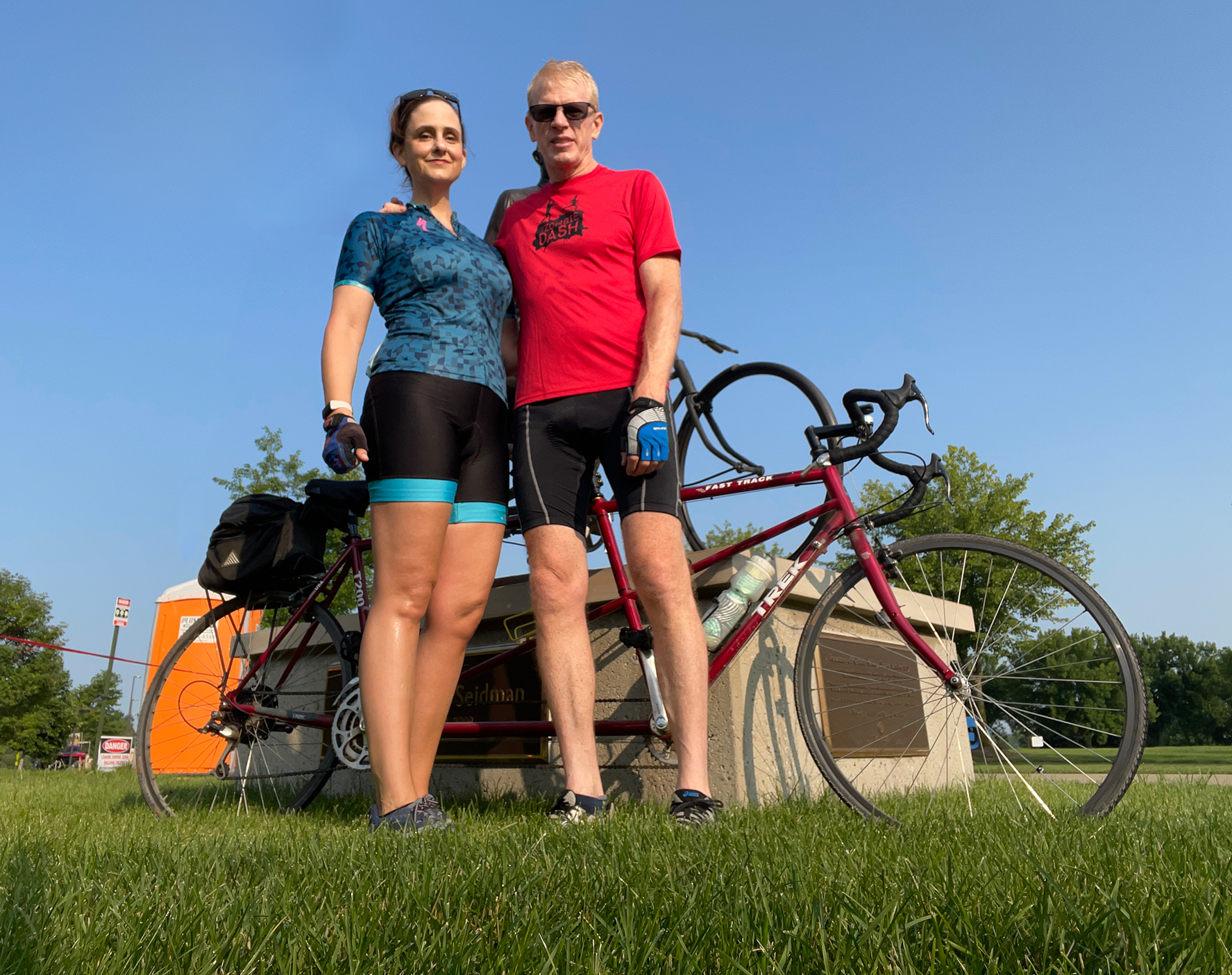
The tandem was given to us by my father-in-law, who was (and still is at age 82) an avid cyclist. He thought that we might as well have it, since no one else in the family would ride the tandem with him. This is probably because my father-in-law, while a brilliant surgeon and a generally very generous human being, apparently was not particularly skilled in communicating with his “stoker” (the rider in the back) while he piloted the front of the bike.
Tandem bicycles have a reputation for being bad for relationships, and with good reason. Good communication is key to actually enjoying a tandem bicycle with your spouse.
On one early ride Mike and I took near one of our favorite beach towns —Frankfort, Michigan—an older couple stopped us to admire our tandem (which I have nicknamed “Wheels DeGrasse Tyson” after the astrophysicist). The couple told us that they’d heard that tandem bicycles were “marriage accelerators”—if you had a good marriage, the tandem had the potential to make it great. But if your relationship was on shaky ground? Well, that’s a warning worth heeding.
To be honest, I was lukewarm on the idea of the tandem from the beginning. Before my RP diagnosis, I’d been a very amateur mountain biker. I loved mountain biking because I found it an excellent way to manage my depression and anxiety after my divorce from my first husband. Because there’s no (safe) way to focus on both the horrible mess you’ve made of your life AND not hitting a tree. And so for brief, beautiful moments alone in the woods, instead of being sad, frustrated and lonely, I became free, fierce and strong.
I knew riding a tandem would be nothing like that.
My husband, like his father, is a road biker. He spends hours on his bike, riding the 20+ miles between our home and the university campus where he teaches during the week. He often adds another 40 or 60 mile on the weekends, riding the backroads and trails between Grand Rapids and Lake Michigan. Before my vision loss, he and I would occasionally ride our road bikes together as a sort of date, but those rides were always a more leisurely ride to hang out, never really a workout (at least for him).
Like many people diagnosed with vision loss later in life (I was 41), at first I was in denial. In fact, the only clue something might be wrong was when my optometrist had referred me to the ophthalmologist because he noticed spots on my retinas. Personally, the only indication I had of any issues with my vision was I couldn’t see well in the dark. And I thought, doesn’t everyone have trouble seeing in the dark? (Turns out my night vision was way worse than everyone else’s, but I had no way of knowing that.)
But after my diagnosis, there was no denying that my vision was slowly getting worse and worse. The only way I can describe what it’s like to see through my eyes is to Imagine wearing a pair of sunglasses with petroleum jelly smeared on the lenses, except for a small area in the very middle. This means I was regularly knocking wine glasses off of every surface within arm’s reach, and often “losing” items like pencils or utensils that I know I just set down directly in front of me.
The final straw came one day in 2020 when I was driving home from the grocery store and came so close to hitting a jogger with my car that I scared myself to death and finally hung up my keys for the last time. There was no way I was going to have a stranger’s death on my conscience. A few weeks later a visual field test confirmed that I was indeed legally blind.
What a devastating day. Until you’ve ugly-cried with your husband on the kitchen floor—deep, heaving sobs, complete with wailing—I’d argue that your relationship still hasn’t hit its deepest layers.
Fortunately, those moments of deep, debilitating grief have been few and far between. Today, rather than letting my vision loss destroy me, my life has mostly become a series of frustrations that I deal with as they come. I’m deeply grateful for the little bit of vision I have left. Honestly, not being able to drive is probably the worst part.